.svg)
What is SIEM?

What is SIEM?
Enterprise security requires visibility. The problem is, the volume of data generated in a modern business’s infrastructure is overwhelming. While an organization may have all the data they need to audit their security standing, making sense of a massive amount of data introduces a new challenge. Security Information and Event Management (SIEM) has emerged as the essential framework for aggregating, analyzing, and acting upon this data in real-time.
The Evolution of SIEM
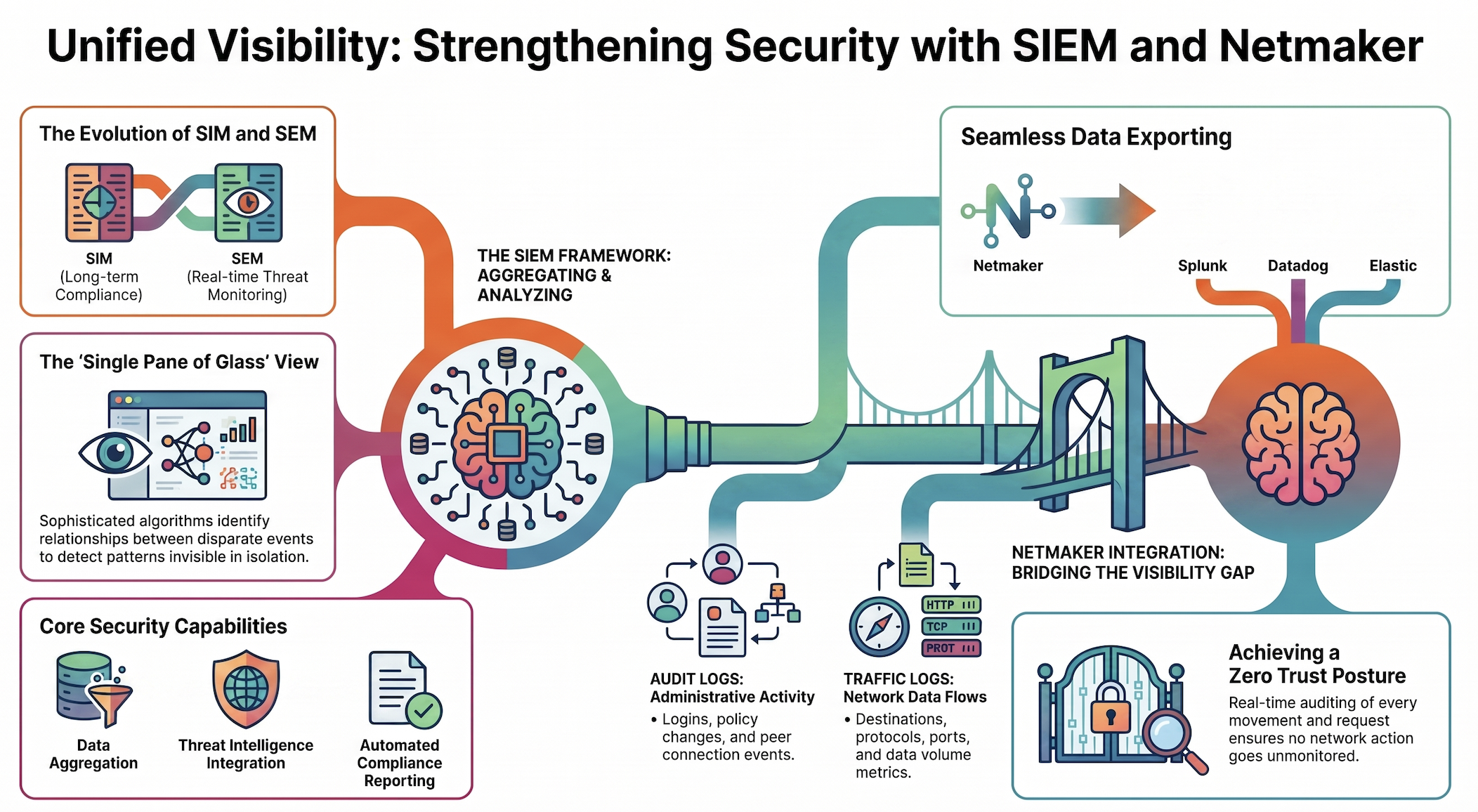
SIEM is a specialized security management discipline that combines two older categories: Security Information Management (SIM) and Security Event Management (SEM).
- Security Information Management (SIM): Focuses on the long-term collection, storage, and analysis of log data for compliance and reporting.
- Security Event Management (SEM): Focuses on real-time monitoring, correlation of events, and notification of immediate security threats.
By merging these functions, a SIEM platform provides security operations centers (SOCs) with a "single pane of glass" view into their environment, allowing them to detect patterns that would be invisible if analyzed in isolation.
Core Capabilities of a SIEM Platform
A mature SIEM solution performs several critical functions to protect an organization's digital assets:
- Data Aggregation: SIEMs collect logs from a vast array of sources, including servers, databases, applications, firewalls, and virtual networks.
- Correlation and Analysis: The platform uses sophisticated algorithms to identify relationships between disparate events. For example, a failed login attempt on a server followed by an unusual outbound traffic flow from the same IP might trigger a high-priority alert.
- Threat Intelligence Integration: Modern SIEMs often ingest external threat feeds to help identify known malicious IP addresses, domains, or malware signatures.
- Reporting and Compliance: For organizations subject to regulations like SOC-2, ISO 27001, or GDPR, SIEMs provide the necessary audit trails to prove that security controls are being monitored and maintained.
Bridging the Gap with Netmaker
As virtual networking becomes more integral to enterprise architecture, it is critical that networking events do not remain siloed. Netmaker facilitates security stack harmony by providing a dedicated SIEM exporter service designed to forward critical platform data directly into existing security tools.
Netmaker natively supports several of the industry's leading SIEM and observability platforms, including:
- Splunk
- Datadog
- Elastic
- Microsoft Sentinel
Integrated Logging for Enhanced Visibility
Netmaker feeds two primary types of data into the SIEM stack to ensure comprehensive oversight:
Audit Logs
These logs track administrative and user activities. This includes every admin action, peer connection event, and policy change made within the system, as well as user logins. By exporting these to a SIEM, security teams can correlate configuration changes with broader infrastructure shifts in real-time.
Network Traffic Logs
Network Traffic Logs provide granular visibility into the actual network data flows both across and exiting the overlay. These logs move beyond simply tracking "who is connected" to detailing "what is happening" by monitoring:
- Request Origination: Identifies who (or what) made the network request.
- Exact Destinations: Identifies devices, services, IPs, or websites accessed.
- Protocol and Port Data: Monitors specific ports and protocols used.
- Data Volume: Tracks metrics on bytes sent and received.
- Connection Time: Tracks how long a specific resource was accessed.
By integrating these metrics into a SIEM, organizations can move towards a complete Zero Trust posture, by ensuring every movement, request, and action within their network is auditable.





.svg)