.svg)
The Sovereign, Zero Trust Overlay: Rebuilding Enterprise Virtual Networks from First Principles

1. The Infrastructure Shift: Why Legacy Networks Are Breaking
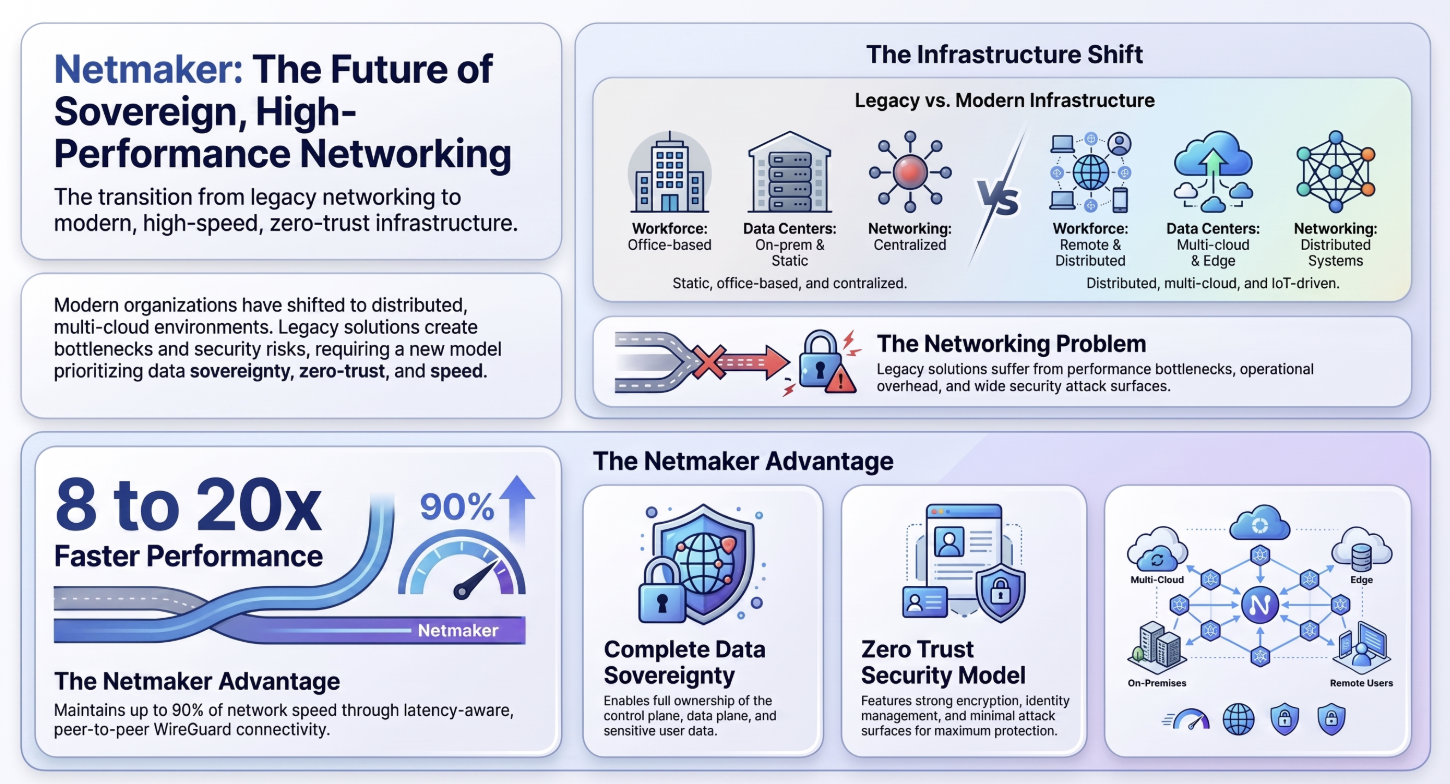
Modern organizations operate across increasingly complex and highly distributed environments. The traditional perimeter-centric virtual network topology, which for decades defined corporate IT, was designed for a static world: an office-based workforce connecting directly to on-premises data centers via a centralized network hub. Today, that paradigm has shifted entirely. Organizations are now characterized by a highly remote workforce, multi-cloud environments, edge and IoT devices, and geographically dispersed distributed systems. However, despite this massive shift in underlying infrastructure, most organizations still rely on legacy virtual network architectures built for the past.
When forced to support modern, distributed workflows, legacy virtual networking and remote access solutions present four fundamental limitations that create a severe bottleneck for digital operations:
- Performance Bottlenecks: Modern workloads require high data transfer speeds. Legacy solutions typically route all virtual traffic through a centralized gateway or hub (a process known as 'hair-pinning' or 'tromboning'). This centralized routing model introduces severe latency overhead and artificial throughput bottlenecks, rendering it completely incapable of handling data-intensive workloads.
- Operational Overhead: Managing access controls, configuration files, and encryption keys across many disparate sites, cloud environments, and thousands of end-users quickly escalates into a complex administrative burden. The lack of automation and centralized coordination leads to human errors and resource drain.
- Security Limitations: Legacy virtual networks rely on outdated security models with wide, exposed attack surfaces. Once a device penetrates the perimeter via a traditional VPN, it is often granted broad, lateral access to the entire local network, violating the core tenets of modern cybersecurity.
- Limited Flexibility: Rigid legacy solutions struggle to dynamically support the operational demands of modern organizations. Scaling connections, deploying in hybrid or multi-cloud settings, and integrating with containerized or ephemeral microservices with legacy virtual networking solutions is slow and limited.
To overcome these challenges, organizations require a virtual networking and remote access solution engineered specifically for modern workflows, one that optimizes data transit, simplifies administration, secures every connection, and adapts dynamically to any infrastructure footprint.
2. Modern Connectivity and Netmaker's Sovereign Overlay
Modern infrastructure demands a modern connectivity solution. Rather than forcing distributed traffic through outdated, rigid solutions, today's architectural standards require a solution that connects systems directly to maintain high performance, enforces strict policy-based access controls at the device level, supports a wide array of environments and use cases, and maintains robust encryption and security end-to-end.
Netmaker is a next-generation Zero Trust networking platform built precisely to fulfill these demands while giving organizations full administrative control and administrative sovereignty over their network infrastructure. By functioning as a high-performance overlay network, Netmaker separates the logical virtual network from the physical underlay, creating encrypted, direct connections over the public internet between diverse endpoints, including remote users, edge devices, cloud infrastructure, and on-premises systems.
At the core of Netmaker's architecture is a fundamental departure from the traditional hub-and-spoke VPN model. While traditional VPNs establish encrypted tunnels from every client to a centralized server (forcing all data traffic to pass through that single point of failure), Netmaker uses a peer-to-peer overlay architecture. Under this model, Netmaker manages a lightweight control plane to coordinate network membership, distribute configuration changes, and manage keys. However, the data plane remains strictly peer-to-peer: once nodes are coordinated, they establish direct, encrypted communication channels with each other. This architectural decoupling of control and data planes eliminates central network bottlenecks, drastically lowers latency, and maximizes overall throughput.
3. The Four Pillars of the Netmaker Advantage
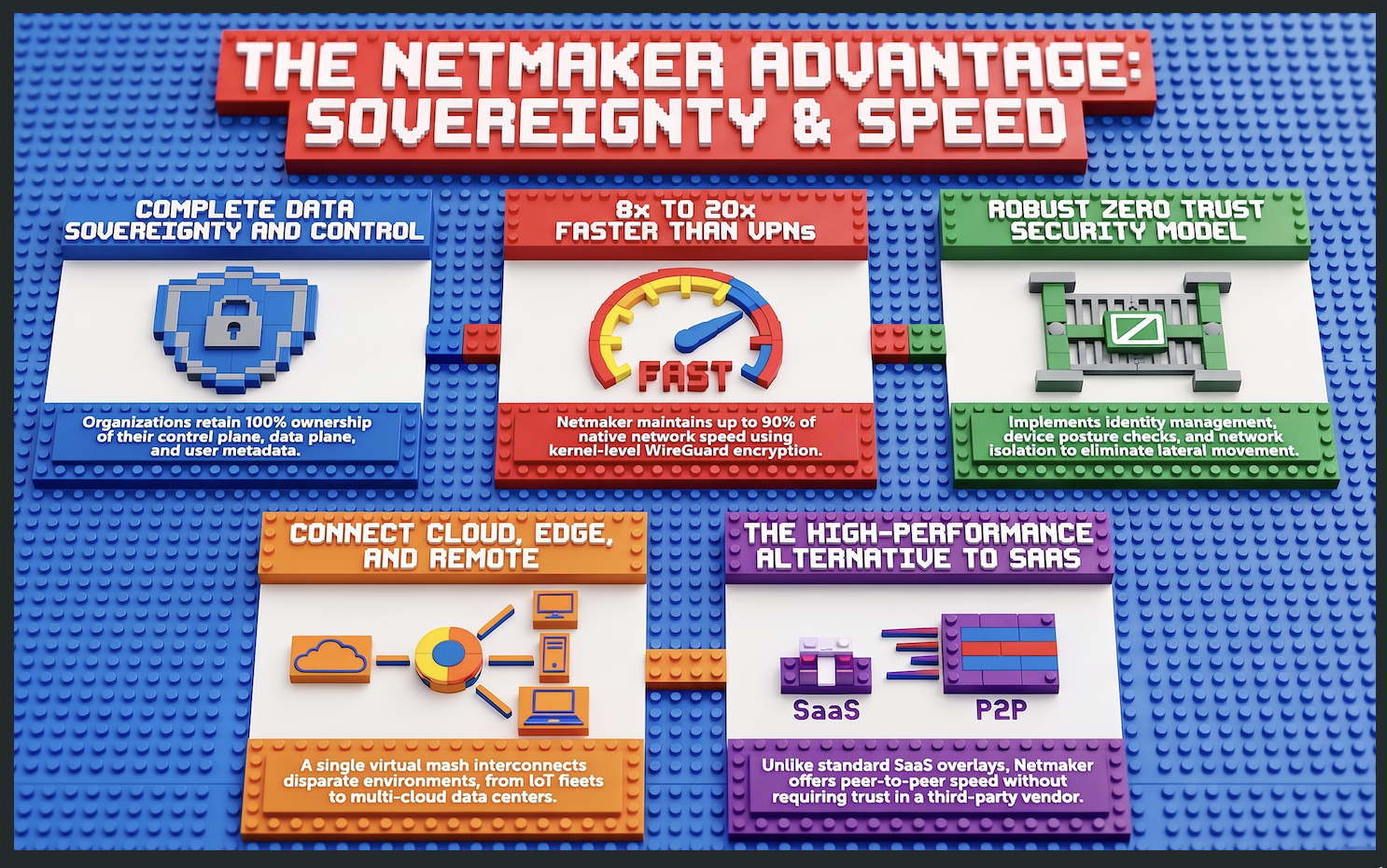
The Netmaker advantage is built on four core pillars that address the structural flaws of both legacy and current overlay solutions: Data Sovereignty, Zero Trust Security, Data Plane Performance, and Network Flexibility.
Pillar I: Complete Data Sovereignty
In modern IT, data sovereignty has become a primary compliance need. Standard Software-as-a-Service (SaaS) virtual networking models force customers to trust a third-party vendor with their sensitive network configurations and, in some cases, routing paths. This forced trust model represents an unacceptable risk for organizations subject to strict regulatory compliance standards and data-handling requirements.
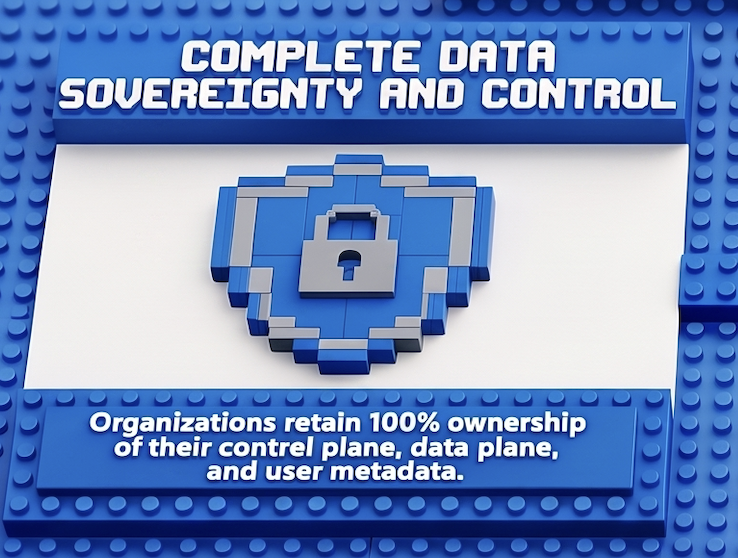
Netmaker is designed to resolve this tension by providing complete data sovereignty. It allows organizations to establish full administrative ownership across every layer of the networking stack:
- Control Plane: Organizations can host and control the orchestrator that manages network coordinates, policy decisions, and membership keys.
- Data Plane: Data traffic flows directly peer-to-peer between authorized devices without passing through vendor-owned relays or middleboxes.
- Network Infrastructure: Complete independence to host the central management controller on public clouds, private clouds, or on-premises physical hardware, even in airgapped environments.
- User Data: All user directory information, access patterns, and metadata remain strictly contained within the organization's private administrative boundaries, ensuring complete alignment with privacy standards.
Pillar II: Zero Trust Security
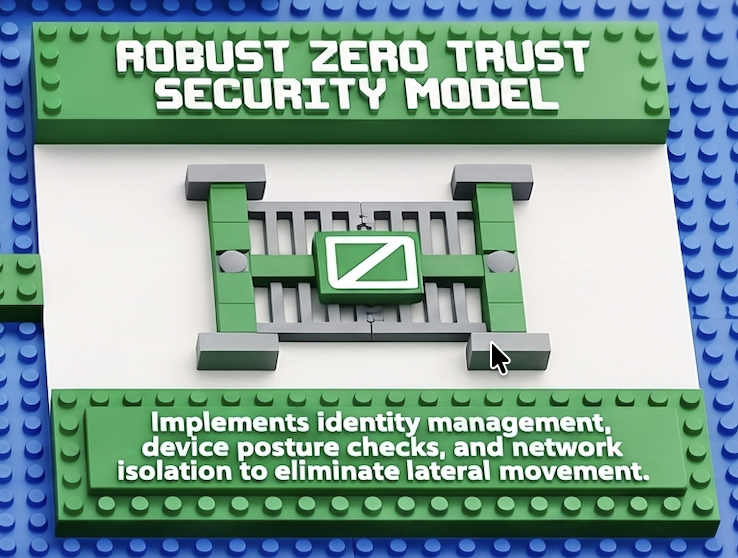
Netmaker implements the latest best practices in Zero Trust from the security industry to enforce a robust defense-in-depth model. Instead of treating the network as a trusted zone once a perimeter is crossed, Netmaker establishes that no device is trusted by default. The platform provides a complete suite of security mechanisms to secure diverse endpoints:
- Strong Encryption: All data transit is protected using state-of-the-art cryptographic primitives.
- Identity Management: Integrates with standard enterprise identity providers to authenticate and authorize users and devices.
- Device Posture Checks: Dynamically evaluates the security status of connecting endpoints to block compromised hardware and unauthorized locations.
- Access Controls & Network Isolation: Enables administrators to partition the overlay network into isolated sub-segments for allowed traffic, preventing lateral movement.
- Observability Tools: Provides continuous visibility and comprehensive logs of all connected peers, configuration changes, and network traffic.
Pillar III: High-Performance Data Plane
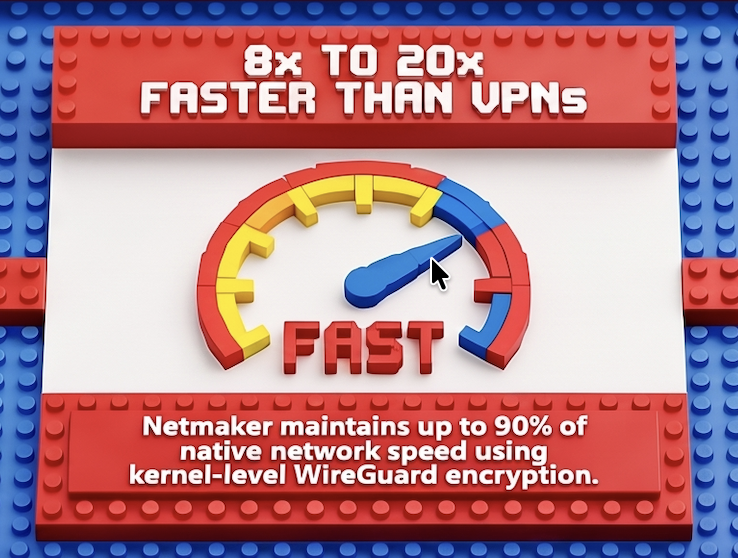
Netmaker's industry-leading performance easily handles data-intensive workloads. Benchmarks demonstrate that Netmaker is 8 to 20 times faster than standard VPN alternatives, maintaining up to 90% of an organization's native, un-encapsulated network speed. The platform achieves this unmatched performance through four key architectural mechanisms:
- Peer-to-Peer Connectivity: Traffic takes the shortest physical path, moving directly from node to node rather than being routed through a centralized bottleneck.
- Modern Encryption (WireGuard): Netmaker is powered by WireGuard, a modern, extremely lightweight cryptographic protocol implemented directly in the operating system kernel, which dramatically reduces context-switching overhead compared to legacy user-space protocols like OpenVPN.
- Latency-Aware Routing: The Netmaker control plane continuously monitors path latency to optimize transit routes across the overlay.
- Dedicated Traffic Relays: When restrictive firewalls or double NATs prevent a direct peer-to-peer connection, Netmaker automatically deploys dedicated, high-speed traffic relays to maintain the link without dropping performance.
Pillar IV: Network Flexibility
Netmaker is the most flexible virtual networking platform on the market, offering low-level controls and deployment options tailored to meet complex, custom organizational requirements. This flexibility is enabled through:
- Multiple Management and Integration Options: Enables the Integration and Management of networks via developer and administrator-friendly APIs, CLIs, in addition to graphical administration panels.
- Network Topology Capabilities: Allows administrators to relay and forward traffic via nodes, in addition to the peer-to-peer system, as well as handle both split and full tunnel traffic.
- Low-Level Device Controls: Enables custom configuration of devices to set ports, MTU, virtual IPs, and more.
- Granular Access Controls: Provides detailed configuration of peer-level access lists, allowing administrators to define who can talk to whom on a per-port and IP basis.
4. Enterprise Deployments: Transforming Remote Access, Cloud, and Edge
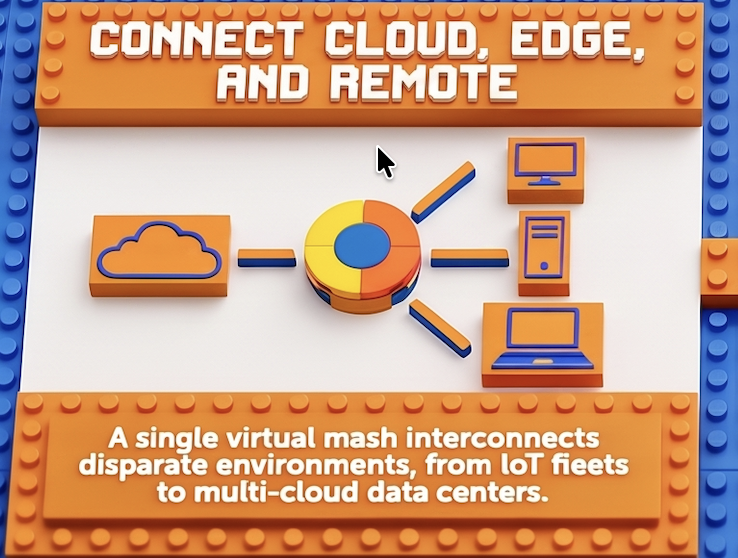
By combining data sovereignty, Zero Trust security, high speed, and operational flexibility, Netmaker enables three key enterprise use cases:
1. Remote Access: Netmaker provides fast and secure remote access to internal resources for distributed employees. Because the virtual network establishes direct, low-latency tunnels, remote workers experience near-native network speeds, increasing productivity for data-intensive developer workflows and remote terminal operations.
2. Site-to-Site Connectivity: Netmaker interconnects disparate infrastructure environments, including public clouds, private data centers, physical corporate offices, and edge sites. It establishes a secure virtual mesh that spans multiple infrastructure provider footprints, allowing seamless multi-cloud coordination without the complexity of traditional BGP routing or static IPSec tunnels.
3. Edge and IoT Management: Netmaker enables secure management of remote edge devices and IoT fleets for monitoring and maintenance. The lightweight footprint of the Netmaker agent and the WireGuard protocol is ideal for resource-constrained edge hardware, maintaining secure connectivity even over highly unstable cellular or satellite links.
Organizations adopting Netmaker have reported significant, measurable benefits across all layers of their IT operations. Data plane latency drops drastically, and overall throughput is enhanced due to the peer-to-peer nature of the connection. Network deployment and management are streamlined by replacing thousands of lines of manual configuration with automated peer coordination. Security is strengthened through the implementation of Zero Trust standards, and operational flexibility is dramatically expanded, allowing rapid deployment of secure virtual networks even when use cases call for complex requirements and strict environments.
5. Strategic Positioning: High-Speed Alternatives for IT Professionals
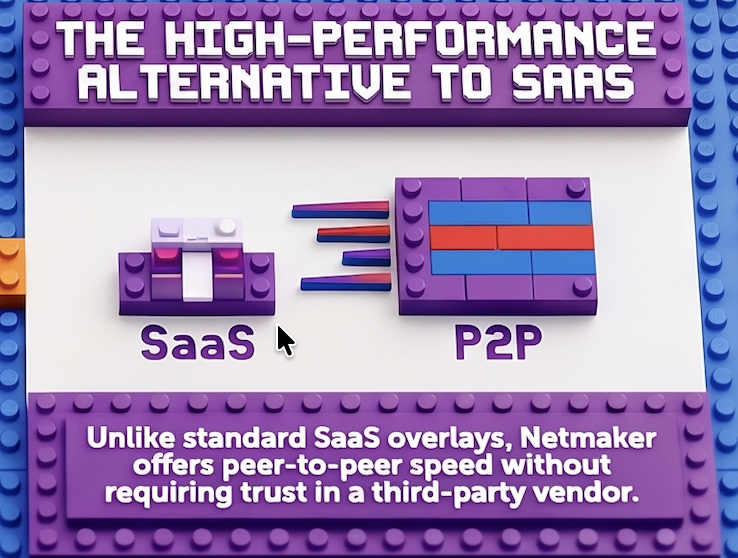
With a wide variety of virtual networking platforms available on the market, IT professionals must carefully evaluate performance, data privacy, and administration features. Historically, organizations had to choose between slow, complex legacy architectures (such as OpenVPN or IPSec) and highly convenient but centralized, vendor-hosted SaaS overlays (such as Tailscale or ZeroTier). Traditional SaaS platforms often require organizations to trust the vendor's cloud with their sensitive metadata and orchestrator keys, introducing a third-party risk vector.
Netmaker is the high-performance alternative specifically engineered for modern IT. It provides the convenience, ease of use, and peer-to-peer performance of modern overlay protocols like WireGuard, while preserving complete hosting independence and administrative sovereignty. Furthermore, unlike consumer-focused overlays, Netmaker is built for IT Ops, featuring a centralized, multi-tenant management dashboard that allows a single operations team to securely orchestrate independent networks for multiple clients, business units, or testing environments from a single pane of glass.
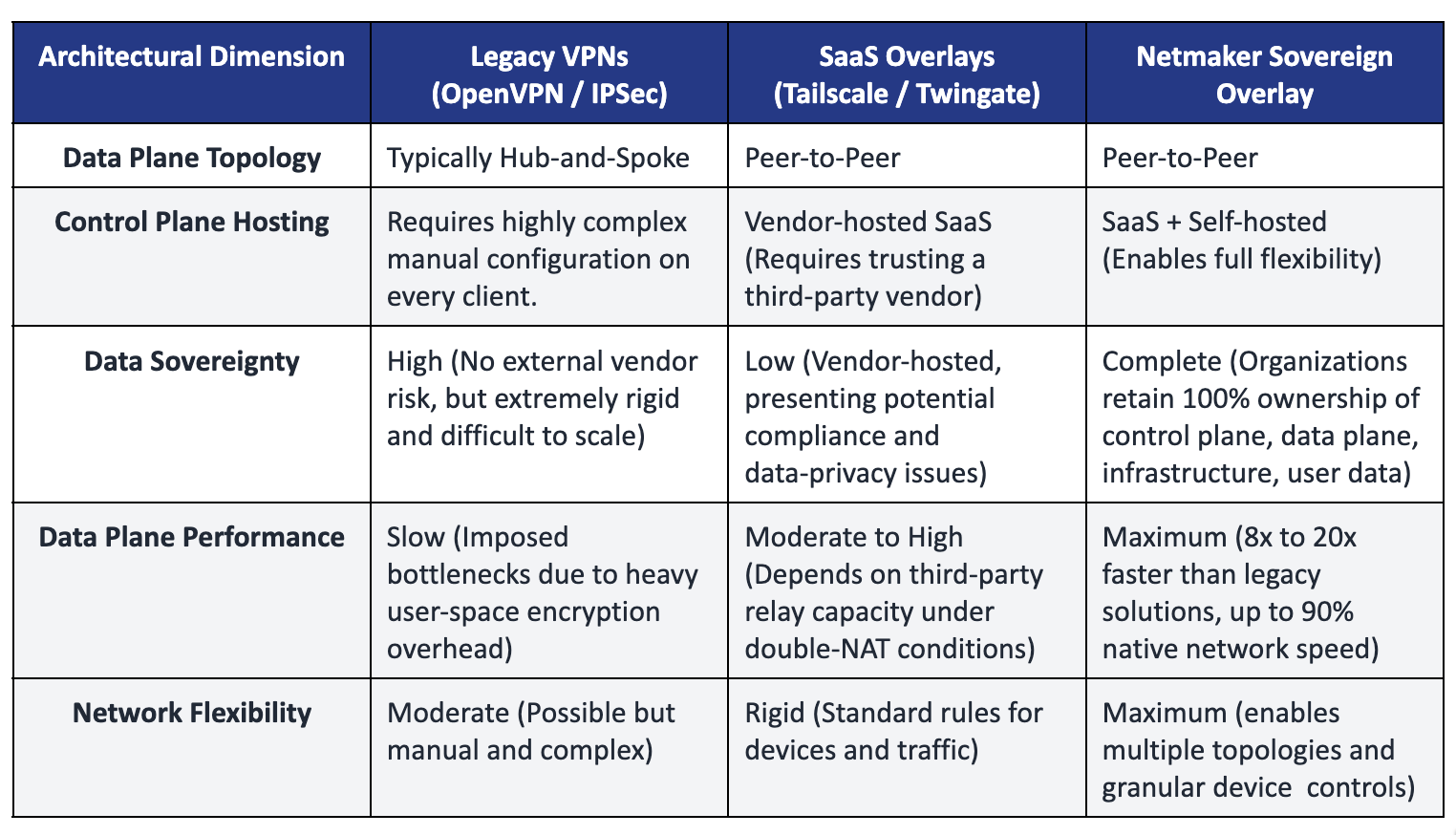
To illustrate these differences, the table below compares the architectural features of traditional legacy VPNs, standard SaaS overlays, and the Netmaker Sovereign Overlay:
6. Conclusion: The Power of Administrative Sovereignty
As digital infrastructure continues to expand across public clouds, physical data centers, and global remote workforces, the virtual networks that bind these environments must adapt. Continuing to rely on outdated, hub-and-spoke legacy VPNs introduces unacceptable performance penalties and operating costs, while adopting vendor-managed SaaS overlays introduces third-party data-privacy risks that complicate regulatory compliance.
Netmaker provides a powerful path forward by delivering the performance, security, and flexibility of modern peer-to-peer overlay protocols without compromising on administrative control. By combining kernel-level WireGuard encryption, Zero Trust security standards, intelligent latency-aware peer-to-peer routing, and centralized, multi-tenant administration that can be hosted anywhere, Netmaker empowers modern enterprise IT Ops and Managed Service Providers to replace their outdated VPN architectures and establish a truly sovereign virtual networking foundation built for the future.





.svg)