.svg)
What is Just-In-Time Access?

Just-In-Time Access: Minimizing Access for Zero Trust Security
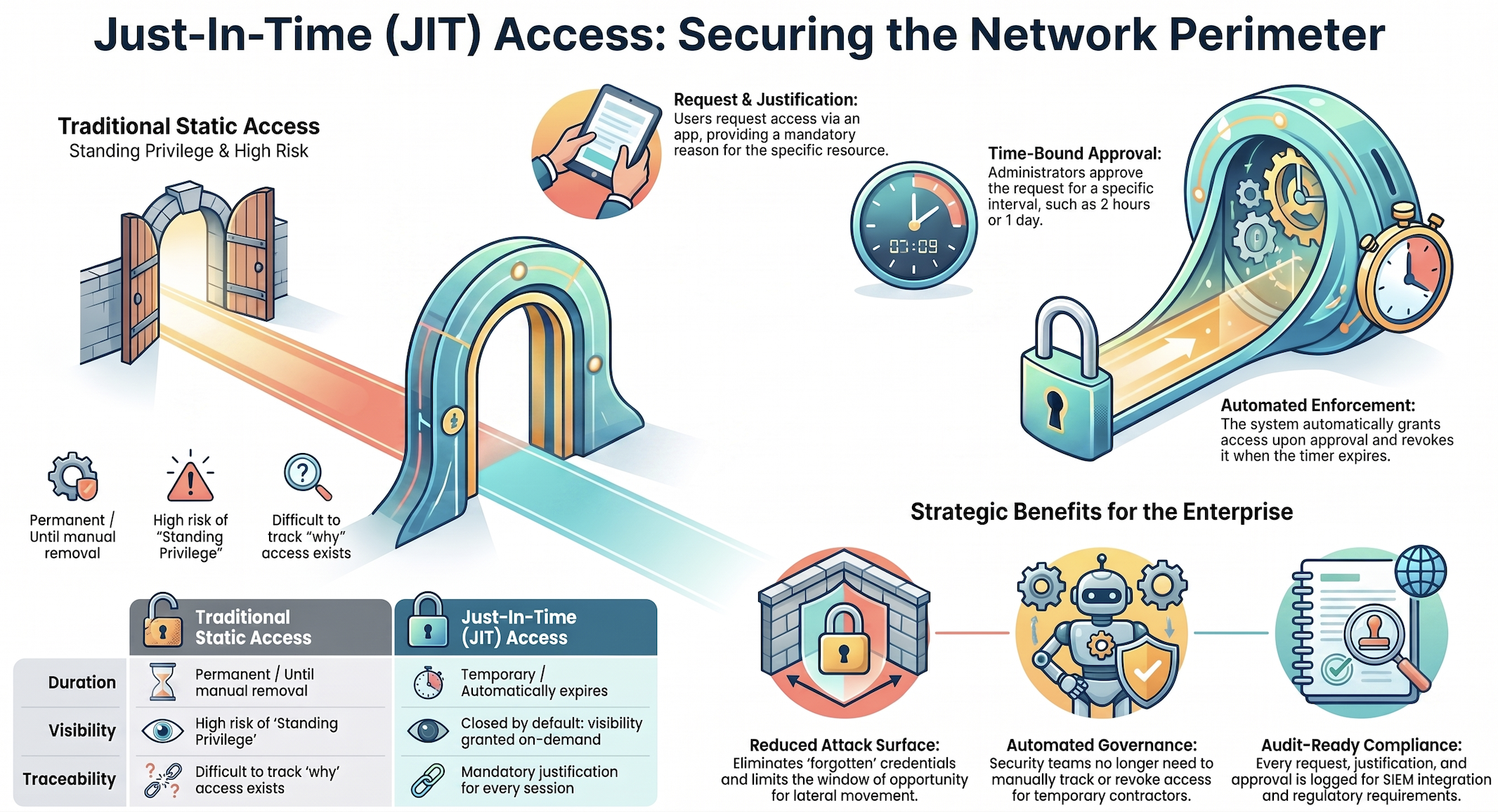
In traditional network security, granting users access to resources often carries significant risk. This is because access typically lasts until an administrator manually removes it. This creates an administrative burden, where user access must be tracked and revoked, while also opening up the possibility of exploitation by malicious actors.
Whether it is a short-term contractor or a remote employee, static permissions act as a "standing privilege" that is inherently insecure, relying on human memory and creating an unnecessary, additional attack surface.
Beyond the threat of 3rd party actors, it also creates a compliance issue when former employees or contractors retain access to sensitive information for longer than intended.
What is Just-In-Time (JIT) Access
Just-In-Time Access (JIT) is a part of the Zero Trust framework. Instead of granting permanent permissions, JIT ensures that users only have access to sensitive resources when they need it, for only as long as they need it, and for a specific, justified reason.
At its core, JIT Access operates on a simple, automated workflow:
- Request: A user requests access to a specific network or resource locally.
- Justification: The user provides a reason for the access (e.g., "Troubleshooting data center metrics").
- Approval: An administrator reviews the request and approves it for a specific duration (e.g., 2 hours, 1 day, 1 week).
- Enforcement: The system automatically grants access immediately upon approval and revokes it once the time limit expires.
This model effectively eliminates the risk of "forgotten" credentials and limits the window of opportunity for lateral movement within a network.
Why JIT is Critical for Modern Enterprises
As organizations move away from legacy VPNs toward decentralized cloud and edge environments, the administrative burden of managing static access continues to grow. JIT provides the answer:
- Reduced Attack Surface: By keeping connections closed by default and limited when granted, you minimize the risk posed by compromised credentials.
- Automated Governance: Security teams no longer need to track when a contractor's project ends; the system handles revocation automatically.
- Compliance and Auditing: Every access request, justification, and approval is logged, providing a clear audit trail for regulatory requirements.
How Netmaker Implements Just-In-Time Access
Netmaker provides Jut-In-Time access as an optional feature in its Enterprise Edition, giving administrators and organizations the ability to implement JIT when and where it makes the most sense.
1. The Approval Workflow
Netmaker automates the JIT process through an interaction between our user application and administrative portal. When JIT is enabled for a network, the "Connect" button in the Netmaker Desktop App is replaced by a "Request Access" button. The user submits their request along with a mandatory justification. Administrators receive an email notification with a direct link to the JIT Requests tab in the Netmaker dashboard to approve or deny the request.
2. Time-Bound Grants
Administrators have full flexibility when granting access. They can select from predefined intervals like 24 hours or one week, or set a custom expiration date. Once approved, the system immediately pushes the configuration to the user's device. When the time expires, Netmaker automatically disconnects the client and reverts the UI to the "Request Access" state. The user receives an email notification both when access is granted, and when it has expired.
3. Group-Based JIT Memberships
Netmaker allows administrators to scope JIT requests to specific user groups per network. This ensures that only authorized personnel can even see the "Request Access" option, further hardening the network perimeter.
4. Advanced Auditing and SIEM Integration
Netmaker's JIT implementation is tied into its observability stack. Every grant is recorded in the platform's Audit Logs. Furthermore, these logs, can be exported directly to SIEM tools like Splunk, Datadog, Elastic, and Microsoft Sentinel, giving security teams insights into when and by whom access was granted.
5. Flexible Hybrid Models
Netmaker recognizes that JIT isn't right for every scenario. Zero Trust Network Access (ZTNA), aloing with MFA and session expiry, might be more suitable for use cases with frequent access across a large user base. JIT can be reserved for high-sensitivity resources or third-party contractors. Netmaker allows you to manage both models simultaneously under a single implementation, and switch it on and off.
Whether you are managing industrial edge systems or a global remote workforce, Netmaker's JIT Access provides the security of a closed network with the flexibility of modern, automated workflows.





.svg)